
- AB-Pressure
Signs Your Exterior Surfaces Need Professional Cleaning
Exterior surfaces rarely become visibly dirty overnight. Grime, algae, mildew, traffic residue, and environmental contaminants build gradually, making it difficult to know when routine rinsing is no longer enough. Persistent staining, uneven discoloration, slippery areas, or repeated organic growth can indicate that deeper cleaning is needed.
Delaying treatment may allow contamination to spread or become more difficult to remove safely. This blog explains the key signs that indicate when professional exterior cleaning is the more appropriate solution.
Visible Signs Your Exterior Surfaces Need Professional Cleaning
The clearest indication that professional cleaning may be necessary is a visible change in how the surface looks. Widespread staining, organic growth, and stubborn residue often show that contamination has progressed beyond what basic household cleaning can remove consistently.
What Causes Dark Streaks, Patches, And Widespread Discoloration?
Dark streaks and uneven patches commonly develop when moisture, airborne particles, organic material, and environmental residue accumulate on exterior surfaces. Siding, concrete, masonry, fencing, and retaining walls can gradually lose their original appearance as these contaminants settle and spread.
Discoloration is not always ordinary aging. When one area becomes noticeably darker than adjacent sections, surface contamination may be masking the material beneath. Vertical streaks can also form where rainwater repeatedly carries residue downward across siding or masonry.
The larger and more uniform the affected area becomes, the less effective spot cleaning usually is. Professional exterior cleaning allows the entire surface to be treated with a method matched to its material and condition, reducing the risk of patchy results.
Is Green Algae, Moss, Or Mildew A Sign That Cleaning Is Needed?
Green, black, or brown growth on exterior surfaces often indicates prolonged moisture exposure. Algae, moss, mildew, and similar biological contaminants are particularly common on shaded siding, patios, concrete walkways, fences, retaining walls, and areas surrounded by vegetation.
These organisms develop more readily where surfaces remain damp for extended periods. Limited sunlight, poor airflow, irrigation overspray, and nearby trees can slow evaporation and create conditions that support recurring growth.
Once biological contamination spreads across a large area, surface rinsing may remove loose material without fully addressing bonded residue. Professional cleaning methods can target the buildup more consistently while accounting for the material beneath it.
What Do Oil, Rust, Tire Marks, And Localized Stains Indicate?
Localized stains require a different approach from general surface dirt. Oil, grease, rust, tire residue, mineral deposits, and vehicle-related contamination often react differently to water and pressure.
Driveways, parking areas, garage approaches, and concrete pads are particularly vulnerable because they receive direct contact from vehicles, metals, runoff, and mechanical equipment.
Increasing pressure is not automatically the correct solution. Some stains respond better to targeted cleaning agents, controlled dwell time, or repeated treatment. Professional cleaning allows the stain type and surface material to guide the process instead of relying on pressure alone.
Surface Changes That Can Signal Deeper Buildup
Not every warning sign is purely visual. Changes in traction, surface brightness, or moisture behavior can reveal contamination that has become established even when staining appears moderate.
Did You Know? A surface can develop a thin layer of algae or organic film before heavy discoloration becomes visible, which is why increased slipperiness after rain may be an earlier warning sign than appearance alone.
Why Do Exterior Surfaces Become Slippery When Wet?
Concrete, pavers, patios, pool surrounds, steps, and walkways can become unusually slick when biological films develop across the surface. Algae and related organic growth can create a thin layer that becomes more noticeable after rain or irrigation.
Shaded areas are often affected first because they dry more slowly. Walkways near vegetation, drainage zones, exterior stairs, and areas around pools may experience repeated moisture exposure that supports continued growth.
Slipperiness is more than an appearance issue because it changes how the surface performs under foot traffic. When normal rinsing does not restore traction, professional cleaning may be necessary to remove the contamination more thoroughly.
Why Can A Surface Still Look Dull After Routine Cleaning?
A surface may appear clean at close range while still looking faded or flat from a distance. This often occurs when a thin layer of residue remains distributed across the material.
Atmospheric contaminants, pollen, fine dirt, oxidation residue, and organic films can reduce contrast and conceal the surface’s original color. Because accumulation occurs gradually, the change may not be obvious until one section is cleaned or compared with a protected area.
Persistent dullness after routine washing suggests the problem is not simply loose dirt. A more controlled cleaning process may be required to remove the film without damaging the underlying finish.
Why Do Porous Surfaces Become Darker Or Uneven?
Concrete, brick, natural stone, and other porous materials contain small openings that can hold water and contaminants near the surface. As dirt, biological residue, and moisture enter these pores, the material may appear darker or develop irregular patches.
Porosity also affects drying. Some areas may retain moisture longer than others, creating visual differences even across the same slab or wall.
Because contamination can sit within the surface texture rather than only on top of it, aggressive surface pressure is not always the best response. Cleaning methods should account for material density, age, joint condition, and the type of buildup present.
What Recurring Exterior Stains Can Tell You
Contamination that repeatedly returns often reflects the surrounding environment rather than a one-time cleaning problem. Understanding where and why stains reappear can help determine whether the surface needs targeted treatment or related maintenance.
Fact: Exterior surfaces exposed to persistent shade, moisture, vegetation, irrigation overspray, or concentrated runoff often experience faster recurring buildup because these conditions allow organic contaminants and residue to reestablish after cleaning.
Why Do Stains Keep Returning In Shaded Areas?
Shaded exterior surfaces typically remain damp longer after rainfall, dew, washing, or irrigation. Slower evaporation creates favorable conditions for algae, mildew, moss, and other organic growth.
North-facing walls, areas beneath trees, narrow passages between buildings, and surfaces blocked from direct sunlight can therefore become dirty faster than more exposed areas.
When staining repeatedly develops in the same location, simply removing the visible layer may provide only temporary improvement. The cleaning approach should account for the type of contamination and the environmental conditions supporting its return.
What Causes Streaking Below Gutters And Rooflines?
Streaks beneath gutters, roof edges, downspouts, and drainage areas often develop because water repeatedly moves contaminants across the same path.
Overflowing gutters may carry decomposed leaves, dirt, roof residue, and organic matter down exterior walls. Downspout discharge can create splashback against foundations, walkways, or siding. Roof runoff may also leave mineral or environmental deposits behind as the water evaporates.
Cleaning can remove the resulting staining, but recurring streaks may signal that gutter flow, drainage, or runoff direction also needs attention. Treating only the visible residue without addressing the moisture path can lead to faster reappearance.
Why Does One Side Of A Property Get Dirtier Faster?
Exterior contamination is rarely distributed evenly. Sunlight, wind direction, nearby trees, road traffic, landscaping, irrigation, roof drainage, and building orientation all influence how quickly individual surfaces collect residue.
A wall facing a busy road may accumulate more traffic film. A shaded side near mature vegetation may develop more biological growth. An area exposed to sprinkler overspray may show mineral deposits or moisture-related staining.
These differences mean exterior cleaning does not always need to follow a rigid whole-property schedule. The condition and exposure of each area provide a more useful basis for deciding when cleaning is necessary.
Signs Routine Diy Cleaning May No Longer Be Enough
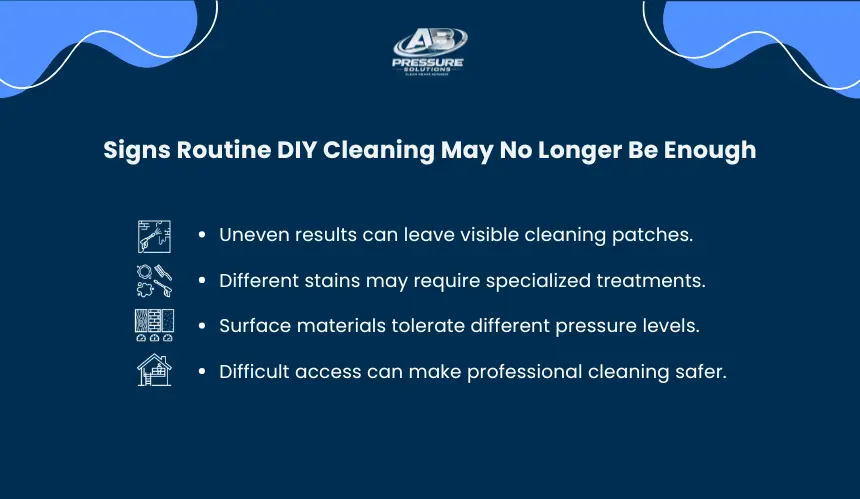
Basic exterior maintenance can handle light surface dirt, but certain conditions require greater control over cleaning chemistry, water flow, pressure, access, and technique. The transition point usually occurs when household cleaning stops producing safe, consistent results.
Did You Know? Using more pressure does not always produce a better clean. On delicate or weathered surfaces, excessive force can damage finishes, joints, coatings, or surface texture, which is why professional cleaning often relies on the correct combination of chemistry, dwell time, water flow, and controlled pressure.
Why Does Diy Cleaning Sometimes Produce Uneven Results?
Hand scrubbing and garden-hose rinsing can work on small areas of fresh contamination, but they become less consistent as the affected area grows.
Different sections may receive unequal scrubbing, detergent contact, or rinsing. The result can be visible lines, lighter patches, or areas where residue remains behind.
Large exterior surfaces also contain joints, corners, texture changes, and vertical sections that are difficult to clean uniformly by hand. Professional equipment and structured cleaning procedures provide greater control over coverage across larger areas.
Which Stains Require Specialized Treatment?
Exterior contaminants do not all respond to the same cleaning process. Organic growth, oil, grease, rust, mineral deposits, oxidation, and atmospheric grime have different chemical and physical properties.
For example, a treatment designed for biological buildup may not remove rust effectively, while a product intended for mineral deposits may be inappropriate for certain painted surfaces.
Professional cleaning relies on identifying both the contaminant and the substrate before treatment. Cleaning chemistry, dilution, dwell time, agitation, rinsing, and pressure can then be adjusted around the specific condition instead of applying one method to every stain.
How Do You Know How Much Pressure A Surface Can Tolerate?
Exterior materials vary significantly in how they respond to water pressure. Concrete can generally tolerate more mechanical force than painted wood, aging stucco, some siding systems, roofing materials, or delicate masonry.
Surface condition matters as much as material type. Cracked mortar, loose paint, deteriorated wood, weakened sealants, or damaged siding may require a gentler approach even when the material would normally tolerate stronger cleaning.
Professional exterior cleaning may involve pressure washing, soft washing, controlled rinsing, or chemical treatment depending on the surface. The goal is to remove contamination with the least aggressive effective method.
When Does Access Make Professional Cleaning The Safer Option?
Cleaning becomes more complicated when contamination is located on upper-story siding, elevated walls, steep surfaces, tall structures, or areas that are difficult to reach from the ground.
Access challenges affect equipment positioning, spray control, water direction, and surrounding property protection. Attempting to clean elevated surfaces from unstable ladders or awkward positions can also create unnecessary safety risks.
Professional service is generally more appropriate when effective cleaning requires specialized access equipment, controlled application from a distance, or experience working around windows, landscaping, electrical fixtures, and adjacent materials.
Which Exterior Areas Should Be Prioritized For Professional Cleaning?
Not every exterior surface requires cleaning at the same time. Priority should be based on surface condition, visibility, traffic, moisture exposure, and the practical effect that contamination has on property use.
Walkways, Steps, Patios, And Other High-Traffic Surfaces
Pedestrian surfaces collect soil, organic residue, food debris, moisture, and material carried by footwear. Because people interact with these areas directly, contamination can affect both appearance and traction.
Steps and walkways deserve particular attention when they become slick, darkened, or heavily stained. Patios and gathering areas may also require more frequent cleaning because furniture, shade, cooking activity, and foot traffic create additional sources of buildup.
Cleaning these surfaces first can address both usability and visual condition in areas people encounter regularly.
Siding And Large Visible Exterior Surfaces
Siding occupies a significant portion of a property’s visible exterior, so streaking, mildew, dirt, and discoloration can affect overall appearance even when individual stains seem minor.
Large vertical surfaces also collect contamination unevenly. Roof runoff, vegetation, shade, vents, and weather exposure can create localized bands or patches across the facade. Because siding materials differ in durability and finish, professional cleaning should match the method to the specific product rather than treating every wall with conventional high pressure.
Driveways And Parking Surfaces
Driveways and parking areas are exposed to vehicle traffic, tire residue, oil, grease, mud, leaf staining, runoff, and airborne contamination. Their large horizontal surface area also makes discoloration easy to notice.
Localized automotive stains may require pretreatment, while widespread grime may need broader surface cleaning for a consistent finish. These surfaces are often strong candidates for professional cleaning when ordinary rinsing leaves behind dark traffic patterns, embedded dirt, or persistent vehicle-related marks.
Frequently Asked Questions
Can professional exterior cleaning remove all stains permanently?
Professional cleaning can remove or significantly reduce many surface contaminants, but not every mark is fully reversible. Permanent discoloration, paint failure, deep rust penetration, efflorescence, etching, or material deterioration may remain after cleaning. A professional assessment helps distinguish removable contamination from damage that requires sealing, repair, refinishing, or replacement.
How can I tell whether a stain is dirt or actual surface damage?
A stain is more likely to be contamination when it changes after rinsing, cleaning, or drying. Surface damage usually remains unchanged and may include flaking paint, pitting, cracks, fading, erosion, or exposed substrate. Testing a small inconspicuous area can help determine whether the issue is removable residue or material deterioration.
Should exterior surfaces be sealed after professional cleaning?
Sealing can be beneficial for certain porous materials such as concrete, pavers, brick, and natural stone, particularly where moisture, oil, or staining is common. However, sealing is not automatically required after cleaning. The surface must be compatible, properly dried, and in suitable condition before a sealer or protective coating is applied.
Can professional cleaning damage plants, windows, or nearby landscaping?
Improper chemical use, uncontrolled runoff, or excessive pressure can affect landscaping and adjacent materials. Professional cleaners typically account for plant protection, pre-wetting, controlled chemical application, rinsing, drainage, and overspray management. Windows, painted trim, outdoor fixtures, and delicate vegetation should be considered before treatment begins, especially around concentrated cleaning solutions.
Is professional exterior cleaning worth it before painting or sealing?
Cleaning is often an essential preparation step before painting, staining, sealing, or applying protective coatings. Dirt, algae, chalking residue, grease, and loose contaminants can interfere with adhesion and produce uneven finishes. The surface must also be allowed to dry properly before coatings are applied, particularly on wood, masonry, and concrete.
Can exterior cleaning reveal hidden problems underneath the dirt?
Removing heavy buildup can expose conditions that were previously concealed, including cracked mortar, deteriorated sealant, loose paint, surface erosion, damaged joints, or previous staining. Cleaning does not cause these existing defects, but it can make them easier to identify. This can be useful before repairs, repainting, sealing, or property maintenance planning.
How soon can exterior surfaces get dirty again after professional cleaning?
Re-soiling depends on exposure rather than a fixed timeframe. Properties near trees, busy roads, sprinklers, shaded areas, coastal air, or frequent runoff may accumulate contamination faster than open, dry locations. Improving drainage, trimming vegetation, correcting irrigation overspray, and maintaining gutters can often extend the clean appearance between professional treatments.