- AB-Pressure
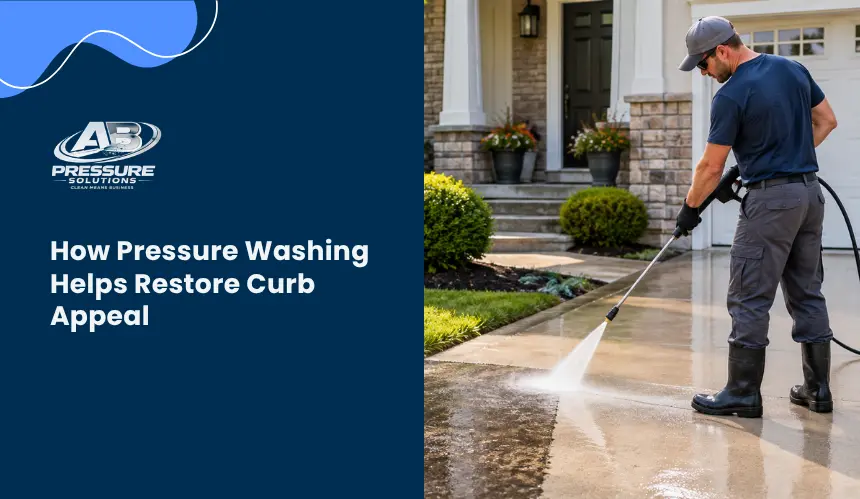
How Pressure Washing Helps Restore Curb Appeal
A property can lose curb appeal long before its exterior surfaces are physically damaged. Dirt, algae, mildew, traffic film, and surface stains gradually dull driveways, walkways, siding, and entry areas, making the property appear less maintained.
Pressure washing can restore a cleaner, more uniform appearance by removing exterior buildup from suitable surfaces and revealing the underlying finish. The effectiveness of the process depends on the surface material, contamination type, and cleaning method used. This guide explains how pressure washing restores curb appeal, which exterior areas benefit most, what affects cleaning results, and how to maintain the improvement.
Why exterior buildup makes a property lose curb appeal
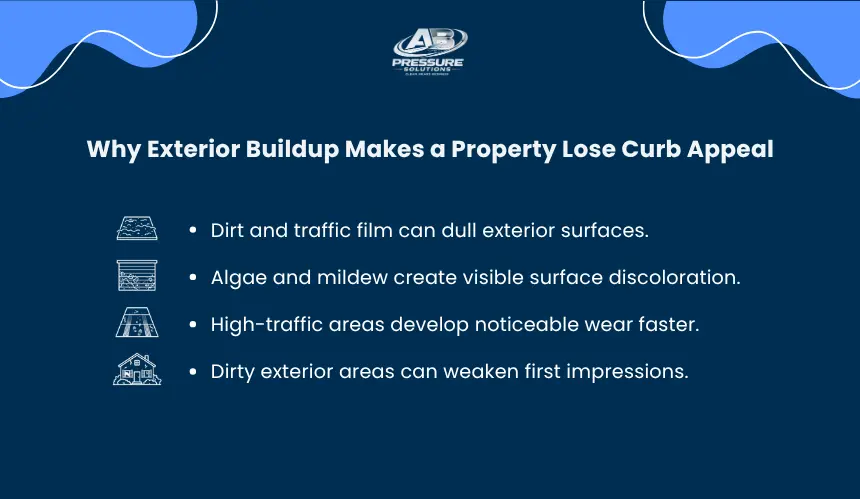
Exterior surfaces are constantly exposed to weather, airborne particles, moisture, organic growth, vehicle residue, and foot traffic. Over time, these contaminants change the way a property looks from the street, even when the structure itself remains in good condition.
Dirt and traffic film dull exterior surfaces
Dust, soil particles, road residue, pollen, and airborne pollutants settle on exterior surfaces and gradually form a visible film. This layer is especially noticeable on light-colored concrete, siding, painted surfaces, and masonry because it reduces contrast and makes finishes appear faded or uneven.
Driveways and areas near roads often collect additional residue from tires, vehicle exhaust, and windblown debris. The accumulation may develop slowly, so the change is not always obvious until a cleaned section is compared with an untreated area.
Pressure washing removes loose and bonded surface contamination from suitable materials. Once the buildup is lifted, the original color and texture become more visible, improving the overall appearance without changing the surface itself.
Algae, mildew, and organic growth create visible discoloration
Moisture, shade, limited airflow, and nearby vegetation can create conditions where algae, mildew, moss, and other organic matter develop on exterior surfaces. These contaminants commonly appear as green, black, brown, or dark gray patches. Organic buildup can be especially noticeable on siding, concrete, retaining walls, steps, patios, and shaded walkways. Because the growth often forms irregular patterns, it makes surfaces appear blotchy and poorly maintained.
Cleaning removes the visible contamination and reduces the contrast between affected and unaffected sections. Depending on the material and severity of growth, treatment may involve controlled pressure, cleaning solutions, or a lower-pressure washing method.
High-traffic areas show wear faster
Some exterior surfaces lose their clean appearance faster because they experience frequent contact with people, vehicles, water, and debris. Driveways collect tire marks, oil residue, dirt, and road contaminants. Walkways accumulate soil from footwear, leaves, mud, and runoff. Entry steps can develop darkened traffic patterns because the same areas are used repeatedly.
These high-visibility surfaces strongly influence first impressions because visitors see them before many other parts of the property. Cleaning them can create a noticeable improvement even when no other exterior changes are made.
How does pressure washing restore a cleaner exterior appearance?
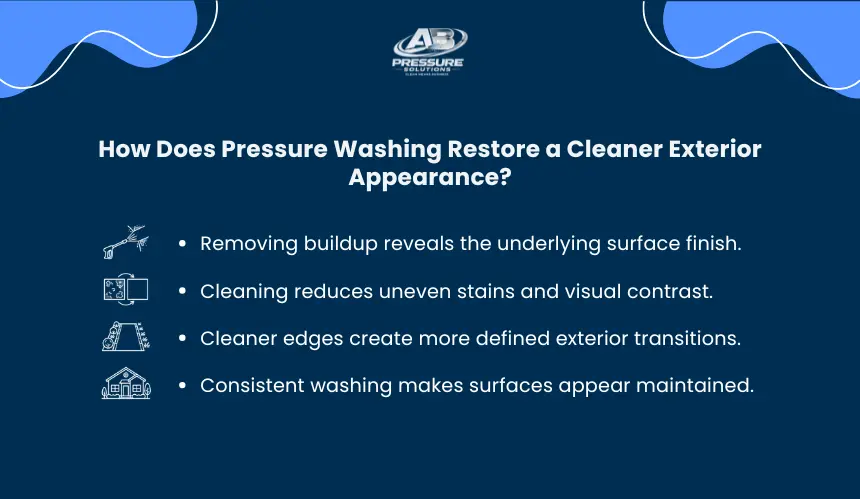
Pressure washing improves curb appeal by removing contamination that changes a surface’s visible color, texture, and consistency. The result comes from cleaning accumulated residue rather than covering or altering the underlying material.
Removing surface buildup reveals the underlying finish
Exterior surfaces often look older than they are because contamination masks their original finish. Concrete may appear darker, brick may lose color definition, and siding may look dull under layers of dirt and organic residue.
A controlled washing process separates contaminants from the surface so they can be rinsed away. On appropriate materials, this exposes more of the original finish and restores clearer visual definition.
The change can be particularly noticeable on large areas such as driveways, walkways, patios, and exterior walls because these surfaces occupy a significant portion of the property’s visible exterior. Cleaning does not restore damaged materials to new condition, but it can reveal that a surface is in better condition than its contaminated appearance suggested.
Cleaning reduces uneven staining and visual contrast
Curb appeal is influenced by consistency. Dark patches, grime lines, algae streaks, and isolated stains interrupt the visual continuity of an exterior surface. Pressure washing can reduce these differences by removing contaminants across the full area rather than treating only obvious spots. This produces a more uniform appearance and prevents cleaned patches from contrasting sharply with surrounding sections.
For persistent contaminants, pressure alone may not be sufficient. Oil, biological growth, rust staining, or deeply embedded residue may require specialized cleaning products or pre-treatment before rinsing. Selecting the correct cleaning process based on the contaminant produces more consistent results than simply increasing pressure.
Defined edges and cleaner transitions make the property look maintained
Curb appeal depends on how exterior features relate visually to one another. A clean walkway beside an overgrown edge, a stained driveway next to fresh landscaping, or a dirty wall above a clean patio can create uneven presentation. Pressure washing can sharpen the boundaries between hard surfaces, landscaping, entry areas, walls, and paved sections by removing buildup along edges and transitions.
Cleaner borders make features appear more defined. Driveway lines become clearer, steps look more distinct, and patios can appear more organized relative to adjacent landscaping. These visual improvements contribute to the perception that the property receives consistent exterior maintenance.
Which exterior areas make the biggest difference when pressure washed?
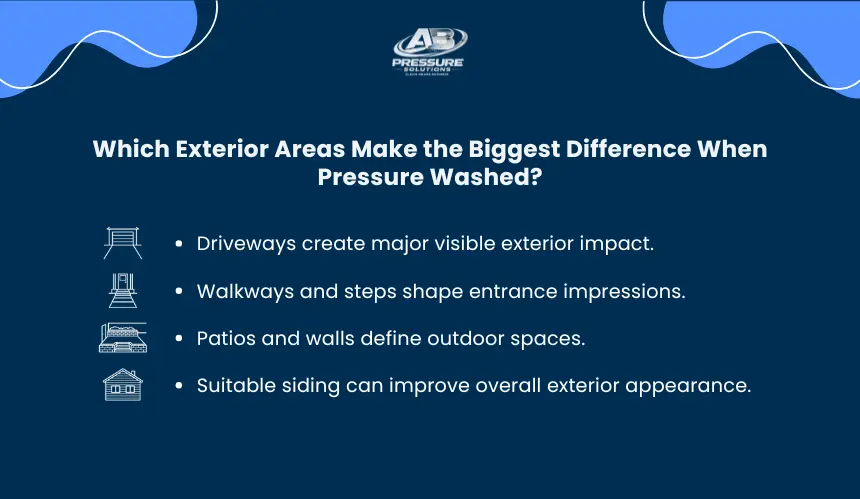
Not every exterior surface contributes equally to curb appeal. Areas that are large, highly visible, or positioned near entrances usually produce the greatest visual impact when cleaned.
Did you know? Cleaning high-visibility surfaces such as driveways, front walkways, steps, and entry zones often produces a stronger curb appeal improvement because these areas dominate the property’s street-level view and shape a visitor’s first visual impression.
Driveways and parking surfaces
Driveways often represent one of the largest visible hard surfaces on a residential property. Their condition can therefore influence how clean the entire exterior appears.
Concrete and other suitable paving materials can collect tire marks, dirt, algae, vehicle fluids, leaf stains, and atmospheric residue. Because these contaminants are spread across a broad area, they can make the driveway appear darker or patchy.
Pressure washing can remove much of this surface contamination and restore more consistent coloration. Cleaning the driveway also improves the transition between the street, landscaping, garage, and entry path. Stains that have penetrated deeply into porous materials may remain partially visible, so results depend on the type and age of the contamination.
Walkways, steps, and entry areas
The path toward the front entrance receives direct visual and physical attention from visitors. Dirt, organic buildup, and traffic residue in these areas can make the property appear neglected even when surrounding features are maintained. Walkways often collect soil from adjacent landscaping, while steps may develop dark patches from repeated foot traffic and retained moisture.
Cleaning these areas creates a more defined approach to the entrance. It can also expose surface conditions that were difficult to evaluate under heavy buildup, such as cracks, worn coatings, or deteriorated joints. Because entry surfaces may include multiple materials, cleaning pressure and technique should be adjusted to each substrate.
Patios, retaining walls, and hardscape features
Patios, garden walls, pavers, stone borders, and retaining walls contribute to the visual structure of outdoor areas. When these features become stained or covered with organic growth, landscaping may appear less defined. Pressure washing can remove soil residue, algae, weather staining, and other surface contaminants from compatible hardscape materials.
Cleaning these features can also improve contrast between masonry, vegetation, lawn areas, and outdoor furniture. This effect is particularly noticeable where pale stone or concrete has darkened over time. Care is required around loose joints, damaged mortar, aging pavers, and delicate stone because excessive pressure can disturb materials or worsen existing deterioration.
Siding and other suitable exterior surfaces
Some siding systems and exterior walls can benefit from professional washing, but the correct method depends heavily on the material. Vinyl siding may tolerate controlled washing under appropriate conditions, while painted wood, stucco, roofing materials, and delicate finishes often require lower pressure or soft-washing techniques.
The goal is to remove contamination without forcing water behind siding, damaging coatings, etching the surface, or disturbing joints. For this reason, improving curb appeal does not always mean using high pressure. Effective exterior cleaning depends on selecting a method that matches the surface.
What determines how much curb appeal pressure washing can restore?
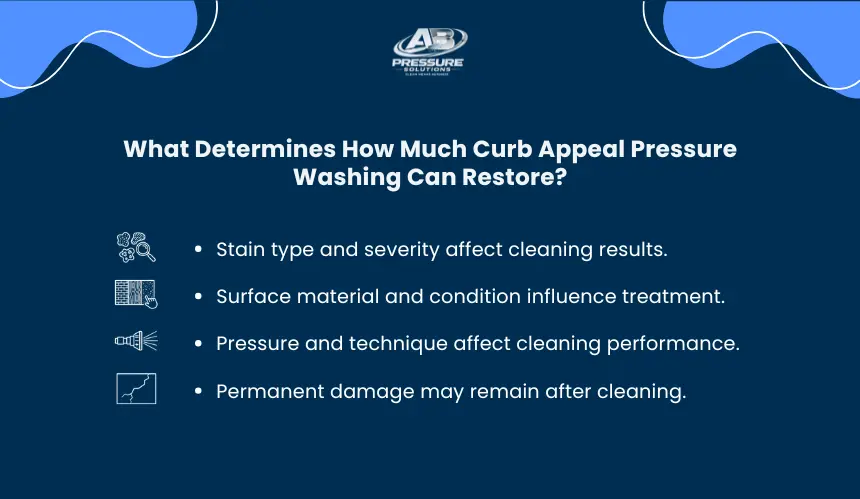
Pressure washing results vary because exterior contamination and surface conditions are rarely identical. The type of stain, material condition, cleaning chemistry, and equipment setup all influence the final appearance.
Did you know? Two surfaces made from the same material can require different pressure washing methods because age, porosity, previous coatings, moisture exposure, and stain penetration all affect how the surface responds to cleaning.
Type and severity of the staining
Loose dirt is generally easier to remove than contamination that has chemically reacted with or penetrated a surface. Algae and mildew may require treatment that breaks down biological growth before rinsing. Oil can enter porous concrete. Rust may leave mineral discoloration. Leaf tannins and irrigation deposits can also produce stains that require targeted treatment.
The longer contamination remains in place, the more difficult complete removal may become. Understanding the stain type helps determine whether standard pressure washing is appropriate or whether pre-treatment and specialized cleaning methods are required.
Surface material and condition
Exterior materials respond differently to pressure, water flow, cleaning solutions, and heat. Concrete is generally more durable than painted wood, but even concrete can be damaged by excessive pressure or improper nozzle placement. Brick may have vulnerable mortar joints. Natural stone can vary significantly in hardness and porosity. Aging siding may already contain cracks or loose sections.
Surface condition matters as much as material type. A newer masonry surface may tolerate cleaning differently than weathered material with existing deterioration. Professional cleaning should therefore begin with an evaluation of both substrate and condition rather than a single pressure setting for every surface.
Pressure, water flow, cleaning solutions, and technique
Cleaning performance is not determined by pressure alone. Water flow, nozzle angle, working distance, cleaning chemistry, dwell time, and operator technique all affect how contaminants are removed. Higher pressure does not automatically produce a better result. Excessive force can etch concrete, damage wood fibers, strip coatings, loosen mortar, or force moisture into vulnerable areas.
The most effective process uses enough cleaning action to remove contamination while minimizing unnecessary stress on the surface. For biological staining or delicate materials, cleaning solutions and lower-pressure rinsing may produce better results than aggressive mechanical force.
Permanent discoloration or surface deterioration
Pressure washing cleans surfaces, but it does not repair physical damage. Faded paint, worn sealers, oxidation, cracks, corrosion, efflorescence, deeply embedded oil, and material deterioration may remain visible after cleaning.
In some cases, washing actually makes these conditions easier to see because dirt is no longer masking them. This distinction matters when setting expectations. Pressure washing can restore cleanliness and visual consistency, but damaged finishes may require painting, sealing, resurfacing, repair, or replacement to achieve a complete exterior restoration.
How can you maximize curb appeal after pressure washing?
The strongest results come from combining effective cleaning with basic exterior maintenance. Once contamination is removed, surrounding features become more noticeable, making coordinated upkeep more valuable.
Fact: A freshly cleaned exterior often makes nearby maintenance issues more visually noticeable, including faded paint, dirty windows, worn landscaping edges, and stained fixtures. Coordinating pressure washing with these smaller upkeep tasks creates a more consistent curb appeal improvement.
Clean high-visibility areas as a coordinated exterior project
Cleaning one isolated surface can improve appearance, but treating visually connected areas often produces a more consistent result. A clean driveway may still contrast with stained walkways or dark entry steps. Similarly, freshly cleaned siding may draw attention to dirty patios or retaining walls.
Prioritizing the driveway, front path, steps, entrance, and other street-facing surfaces creates visual continuity across the property. The objective is not to clean every exterior feature unnecessarily, but to focus on the areas that collectively shape first impressions.
Address the causes of recurring buildup
Some contamination returns quickly because environmental conditions remain unchanged. Poor drainage can keep concrete damp. Overhanging vegetation can reduce airflow and increase shade. Irrigation overspray may leave mineral deposits. Soil runoff can repeatedly stain walkways.
Correcting these conditions can slow the return of algae, mildew, dirt, and discoloration. Trimming vegetation, improving drainage, adjusting sprinklers, clearing debris, and reducing persistent moisture can extend the visual benefits of professional exterior cleaning.
Combine cleaning with simple exterior maintenance
Pressure washing can create a stronger base for other curb appeal improvements because it removes the contamination that makes surrounding features appear dull. After cleaning, tasks such as trimming landscaping, washing windows, clearing gutters, touching up damaged paint, cleaning exterior fixtures, or refreshing mulch may have greater visual impact.
The sequence also matters. Cleaning hard surfaces before making small cosmetic improvements prevents dirt and runoff from interfering with finished work. Coordinated maintenance produces a more complete exterior presentation than relying on a single cleaning task.
Use professional cleaning when surfaces require controlled treatment
Professional service is most valuable when the property includes delicate materials, extensive staining, difficult access, multiple surface types, or contamination that requires specialized treatment.
A trained provider can adjust pressure, water flow, nozzle selection, cleaning solutions, and technique based on the surface rather than using one aggressive method throughout the property. This reduces the risk of damage while improving cleaning consistency across different exterior areas.
Frequently Asked Questions
Does pressure washing actually increase a home's value before selling?
Pressure washing does not directly change a property’s appraised value, but it can improve buyer perception by making driveways, walkways, siding, and entry areas look cleaner and better maintained. Before listing a home, exterior cleaning can strengthen first impressions, improve listing photos, and reduce visible signs of deferred maintenance.
How long does a property stay clean after pressure washing?
Results may last several months to more than a year depending on shade, humidity, nearby trees, drainage, traffic, and exposure to airborne debris. Properties with persistent moisture or dense vegetation often develop algae and organic buildup sooner. Routine sweeping, drainage correction, and vegetation control can extend the clean appearance.
Is it better to pressure wash before painting or sealing exterior surfaces?
Cleaning should generally occur before painting, staining, or sealing because coatings adhere more effectively to surfaces free from dirt, biological growth, grease, and loose residue. The substrate must also dry completely before finishing work begins. Preparation requirements vary by material, so manufacturer drying and surface-preparation guidelines should be followed.
How far in advance should you pressure wash before listing a house for sale?
Exterior cleaning is often most effective when scheduled shortly before photography, showings, or open-house preparation, while still allowing surfaces enough time to dry. Completing pressure washing before landscaping touch-ups, exterior painting, or staging can also prevent dirty runoff from affecting newly finished areas and help create a more consistent presentation.
Can pressure washing make an old driveway look new again?
Pressure washing can significantly brighten an older driveway when discoloration mainly comes from dirt, algae, tire residue, or surface grime. It cannot reverse cracks, aggregate loss, permanent oil penetration, spalling, or weather-related deterioration. Heavily worn concrete may need sealing, resurfacing, stain treatment, or repairs after cleaning.
Should concrete be sealed after pressure washing?
Sealing can be useful when the concrete is in suitable condition and needs additional resistance to moisture, staining, deicing salts, or surface wear. Pressure washing first removes contaminants that could interfere with sealer adhesion. The concrete should be thoroughly dry, and the selected sealer must match the substrate and exposure conditions.